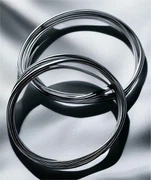
Basically, according to the American standard (ASTM F67), the maximum oxygen percentage defines the commercially pure grade of titanium. C.p. titanium grade 1 has the highest purity due to its low oxygen and iron content, while c.p. titanium grade 4 has the highest oxygen and iron percentages. Implants are made of a variety of different c.p. titanium grades. For example, Bránemark systeme im implants (Nobel Biocare, Sweden) are made of c.p. grade 1 titanium, while ITe implants (Straumann. Switzerland) are made of c.p. grade 4 titanium.
Titanium alloys are designed in grades ASTM 5 to 29, and some manufacturers use grade 5 titanium alloy, usually designated Ti-6Al-4V, for dental implants. In general, c.p. grade 1 titanium exhibits the highest corrosion resistance and the lowest strength, while grades 4 (titanium) and 5 (titanium alloys) exhibit higher yield strengths. Since corrosion resistance depends almost entirely on the iron content, some dental implant manufacturers use grade 4 titanium, which has a higher iron content.
Several dental implant manufacturers (e.g. Astra Tech of Sweden) use grade 4 titanium, in which the iron content is limited to below the maximum allowed for grade 1.
Implant geometryRoot-forming dental implants are designed with a wide variety of body geometries. Implants were previously divided into screw, cylinder and hollow basket shapes. Today, the last group is considered obsolete, while the distinction between screw types (i.e. with threads) and cylinder types has become blurred. The terms threaded and non-threaded implants are often used as synonyms for screw and cylinder implants. Both screws and cylinders are manufactured with straight, tapered, conical, ovoid or trapezoidal walls. Variations in the shape of threads, supplementary vents, grooves and steps add to the complexity of characterizing implants by geometry. There are even implants designed to enlarge the apical part after placement in the prepared bone tissue. There seems to be a trend to produce implants with a three-dimensional morphology that changes along the vertical axis. Figure 1 illustrates the wide variation in the geometry of root-forming implants. In addition, some dentists place mandibular, blade, or framework implants, but these are very rare and will not be described further in this report. Subperiosteal and submucosal implants are now considered obsolete.